To understand Hungarian cuisine, you must first understand paprika. This vivid red spice is not simply a flavoring; it is the foundation upon which nearly every significant Hungarian dish is built. Goulash, paprikash, lecsó, many sausages, and dozens of regional preparations all depend on paprika for their character, color, and depth. Hungary produces some of the finest paprika in the world, and the country's relationship with this spice stretches back centuries.
How Paprika Came to Hungary
The pepper plant (Capsicum annuum) is native to the Americas and was brought to Europe by Spanish and Portuguese traders in the 16th century. From Spain, pepper plants spread across the Mediterranean and eventually reached the Ottoman Empire. It was through the Ottomans, during their 150-year occupation of Hungary (1541-1699), that peppers first arrived on Hungarian soil.
Initially, Hungarian peasants grew the peppers as ornamental garden plants and folk medicine. Wealthy Hungarians initially dismissed it as a "peasant spice." But by the late 18th century, paprika had begun replacing expensive black pepper in Hungarian cooking, and by the 19th century it had become the defining spice of the cuisine.
A breakthrough came in 1920, when a Szeged breeder named Odon Horvath developed a technique for removing the spicy veins and seeds from the peppers before grinding, allowing the production of mild, sweet paprika that could be used in large quantities for flavor and color without excessive heat. This innovation made the mild, richly flavored paprika style that is most associated with Hungarian cooking today.
The Growing Regions
Hungary has two primary paprika-producing regions, both in the southern part of the country where the climate is warmest and sunniest:
- Szeged: Located on the Tisza River in southern Hungary, Szeged is the most famous paprika-producing city in the world. Szegedi fuszerpaprika (Szeged spice paprika) holds a Protected Designation of Origin (PDO) under EU law, meaning only paprika grown and processed in the Szeged region can bear this name.
- Kalocsa: Situated along the Danube, Kalocsa is Szeged's rival in paprika production. The town hosts an annual paprika festival and has a Paprika Museum dedicated to the history and production of the spice.
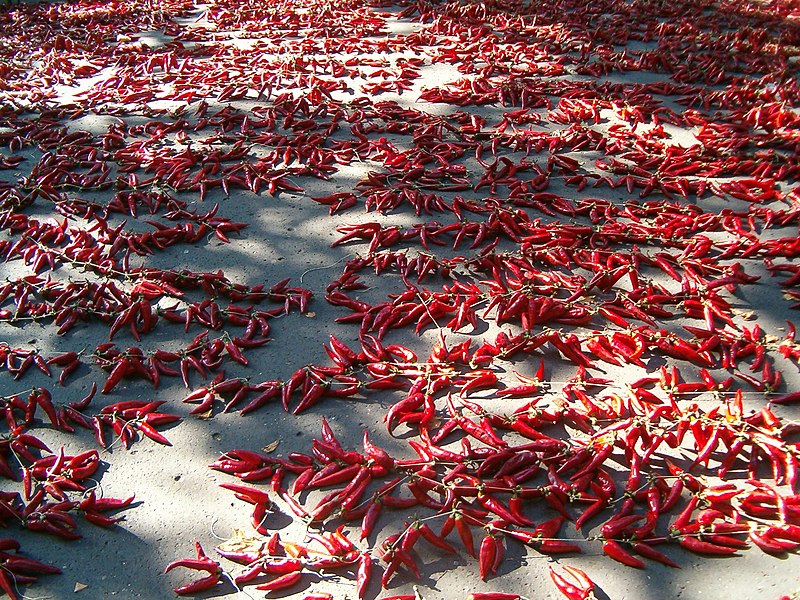
The harvesting season runs from late August through October. Traditionally, the peppers are strung on long threads and hung to dry on the whitewashed walls of farmhouses, creating the striking visual that has become an icon of Hungarian rural life.
Paprika is to Hungarian cooking what butter is to French, olive oil to Italian, and soy sauce to Japanese. It is not an ingredient; it is the language in which Hungarian food speaks.
Culinary observationThe Eight Official Grades of Hungarian Paprika
Hungarian paprika is classified into eight grades, ranging from mild and sweet to intensely hot. Understanding these grades is essential for cooking authentic Hungarian food, as using the wrong type can drastically alter a dish.
- Kulonleges (Special): The mildest grade, with a bright red color and a delicate, barely perceptible sweetness. Used when you want color and a subtle flavor without any heat.
- Edes Nemes (Noble Sweet): Slightly more pronounced flavor than Special, still mild with a rich red color. The most commonly used grade in Hungarian home cooking.
- Feledes (Semi-Sweet): A middle-ground option with a hint of warmth. Good for dishes where you want some depth without significant heat.
- Rozsa (Rose): Pale red with moderate heat. Named for its lighter color, which comes from the specific pepper varieties used.
- Csipős Csemege (Pungent Delicacy): Similar in color to Noble Sweet but with noticeable heat. A good everyday cooking paprika for those who enjoy some spice.
- Csemege (Delicacy): Deep red with a more complex flavor profile and light to medium heat.
- Csipős Eros (Hot Pungent): Significantly hotter, used sparingly in cooking or at the table as a finishing spice.
- Eros (Hot): The hottest grade, ground from peppers including their seeds and veins. This is the paprika used to make Eros Pista, Hungary's famous hot pepper paste.
Buying Tip
When shopping for Hungarian paprika, look for tins or packages from Szeged or Kalocsa. Freshness matters enormously with paprika. Buy in small quantities and replace it every 6 to 12 months. Stale paprika loses its vibrant color and develops a dusty, flat taste. Store it in a cool, dark place, away from direct sunlight and heat.
How to Use Paprika Properly
The most important rule when cooking with paprika is this: never add it to hot oil or a very hot pan. Paprika contains sugars that burn easily, turning the spice bitter and acrid. Instead, always remove the pan from direct heat before adding paprika, or add it to a liquid base.
In most Hungarian recipes, the process follows these steps:
- Cook onions slowly in fat (lard, butter, or oil) until soft
- Remove the pan from heat
- Stir in the paprika, coating the onions
- Immediately add meat or liquid to prevent the paprika from scorching
This technique, called "paprika roux" by some chefs, is the foundation of goulash, paprikash, and dozens of other Hungarian dishes. Mastering it is the single most important skill in Hungarian cooking.
Paprika in Hungarian Culture
The significance of paprika extends well beyond the kitchen. It is one of the official national symbols of Hungary, alongside the Turul bird and the Holy Crown. Hungarian Nobel Prize winner Albert Szent-Gyorgyi made his breakthrough discovery of vitamin C in 1932 by extracting it from Szeged paprika peppers, a finding that earned him the Nobel Prize in Physiology or Medicine in 1937.
Paprika festivals are held annually in both Szeged and Kalocsa, attracting visitors from across Europe. These events feature cooking competitions, paprika-stringing contests, folk music, and markets selling every imaginable paprika product, from ground spice and paste to paprika-infused chocolates and spirits.
For detailed scientific and historical information about paprika, the Wikipedia article on paprika offers an extensive resource.
Quick Reference
For goulash: use Edes Nemes (Noble Sweet) as the base, with a small amount of Csipős Csemege for warmth. For paprikash: use only Edes Nemes or Kulonleges, since the sour cream in the sauce amplifies any heat. For langos: a dusting of Eros adds a pleasant kick to the sour cream topping.